
Last Updated: November 4, 2026
Quick Summary
A tennis training schedule for faster movement should combine first-step practice, controlled stops, strength work, recovery, and movement linked to shots. Schedule two focused movement sessions each week, with a day between them when possible, and progress from planned footwork to reactive cues while maintaining good control.
- Warm up before footwork drills, sprints, or jumps.
- Use body-weight exercises such as squats, side lunges, and single-leg balance.
- Count a match as a demanding court session and reduce or skip the next hard movement workout.
- Stop drills if you experience sharp pain, repeated loss of balance, or declining movement quality.
Table of Contents
- Tennis Training Schedule for Faster Movement: What You’ll Need
- Step 1: Build Tennis Footwork Drills for Speed Into Your Week
- Step 2: Add Tennis Strength Training for Explosive Movement
- Step 3: Follow a 6-Week Tennis Speed and Agility Plan
- Step 4: Connect Faster Movement to On-Court Practice
- Common Mistakes to Avoid in Your Tennis Training Schedule
- Put Your Movement Plan Into Practice With Crunch Time Coaching
- Frequently Asked Questions
Tennis Training Schedule for Faster Movement: What You’ll Need
A tennis training schedule for faster movement works best when it trains the first step, the stop, and the next shot together. Tennis training is a planned mix of movement practice, strength work, and recovery that helps players move with control on court.
A published 2025 intervention used three 60-minute training sessions each week for 12 weeks, according to Physical Function Training Strategies for Improving Tennis. The supplied study summary does not report its results, so use the schedule as an example, not a promise of faster play.
Start with a clear court space, comfortable shoes, and a few cones or court lines. You can also train at home without equipment.
| Session | Main focus | Simple option |
|---|---|---|
| Footwork day | First step and lateral movement | Court lines |
| Strength day | Balance and explosive power | Body-weight moves |
| Court day | Movement into shots | Rally patterns |
| Recovery day | Rest and easy mobility | Walk or gentle stretch |
This guide gives you a weekly structure and drill timings.
Step 1: Build Tennis Footwork Drills for Speed Into Your Week
Tennis footwork drills for speed should train acceleration, deceleration, and a clean split step. Start each session with a dynamic warm-up, then practice short bursts with full control. Fast feet matter, but stopping in balance helps you reach the next ball.
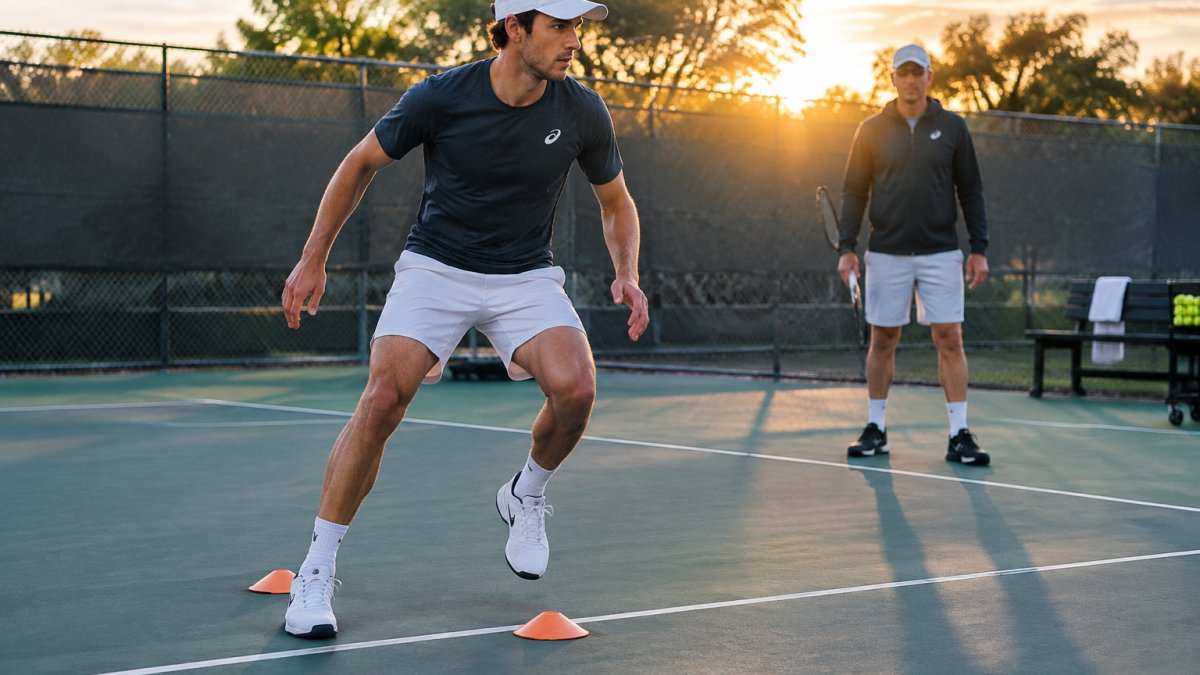
Try this short session:
- Warm up: Jog lightly, then use dynamic stretching and side steps.
- Split-step starts: Do five short starts from a ready stance.
- Lateral shuffles: Move between two court lines, then stop in balance.
- Reactive sprints: Have a partner point left or right before you move.
- Reset: Walk until your breathing feels calm before the next round.
A common mistake is rushing every drill. Keep each burst sharp, then rest enough to keep your form steady. For a focused progression, read our tennis footwork speed guide.
Step 2: Add Tennis Strength Training for Explosive Movement
Tennis strength training for explosive movement should build functional strength without making every session exhausting. Use controlled body-weight work for balance, core engagement, and power, then add small jumps only if you can land quietly and stay steady.
A simple session can include:
- Single-leg balance: Hold a steady stance, then switch sides.
- Squats: Lower with control and stand up with intent.
- Side lunges: Push from one leg and keep your chest tall.
- Small jumps: Land softly with knees aligned over your feet.
Strength supports movement mechanics, but it cannot replace court practice. Keep the focus on clean movement and stop a drill when your form slips. A 2025 case study of a sub-elite female player reported maintained and improved straight-line speed and 3RM strength after individualized, sport-specific training; the available summary gives no numerical change. See [the study record on sport-specific tennis training | https://research.usc.edu.au/esploro/outputs/journalArticle/The-Physiological-Demands-Of-Tennis-And/99450179502621].
Step 3: Follow a 6-Week Tennis Speed and Agility Plan
Use this six-week framework to progress from controlled movement to tennis-specific reactions without turning every practice into a conditioning test. Schedule two focused movement sessions each week, ideally with a day between them; a third court session can combine movement with strokes rather than adding another block of isolated sprints. If you have a match, count it as a demanding court session and reduce or skip the next hard movement workout.
| Weeks | Session A | Session B | Progression goal |
|---|---|---|---|
| 1-2 | Ready-position starts and short lateral shuffles | Controlled deceleration and balance | Learn to push off, arrive under control, and recover without rushing |
| 3-4 | Short forward and diagonal accelerations | Planned changes of direction between court lines | Add direction changes while keeping the same landing and stopping quality |
| 5-6 | Partner- or coach-cued first steps | Random ball feeds followed by recovery to a useful position | Respond to a cue and connect movement to the next shot |
For each session, warm up first, then complete two or three drill types. Start with a small number of short repetitions, such as three to five starts or changes of direction per side, and rest until you can repeat the movement with good control. These are starting points, not a universal prescription: shorten the session if your technique deteriorates, and do not add repetitions just to feel exhausted. Progress one variable at a time, such as adding a cue or changing the direction, rather than increasing speed, volume, and complexity together.
A practical weekly layout is Monday for movement and acceleration, Wednesday for strength or easy mobility, and Friday for court movement linked to strokes. Move the sessions to fit your tennis calendar, but avoid placing the hardest footwork work immediately before an important match. Keep at least one easier or recovery day after a demanding session when possible. Consistent adherence to this balanced structure serves as a foundational element for preventing athlete injuries while ensuring your body remains resilient enough to handle the rigors of competitive play.
Age-aware adjustment: Younger players should prioritize coordination, balanced stops, and short, varied activities that fit their experience and attention; avoid treating adult training volume as a target. Adult recreational players can begin with planned movements and build toward reactive cues as control improves. Masters players, or anyone returning from a layoff, may need longer recovery, fewer high-impact repetitions, and a slower progression to hard stops and jumps. Age alone does not determine readiness: pain, training history, movement quality, and recovery should guide the adjustment.
Watch out: Sharp pain, repeated loss of balance, or a clear decline in movement quality is a reason to stop the drill rather than push through the planned repetitions.
This is a practical progression, not a research-validated six-week protocol or a guarantee of faster movement. Keep a simple log of the drill, repetitions, perceived effort, and how you felt the next day; use it to decide whether to repeat, progress, or scale back the next session. For cone drills that support change of direction, use our tennis cone agility drills.
Step 4: Connect Faster Movement to On-Court Practice
A useful speed session should teach you to read the ball, move into a hitting position, strike with balance, and recover for the next shot. This section bridges a common gap in training plans: instead of separating fitness drills from tennis practice, use a simple feed or rally to make the movement serve a real stroke.
Use a movement-to-stroke sequence
- Set up: Begin near the center of the area you are practicing, in a balanced ready position. Your partner or coach stands where they can feed safely and consistently.
- Read and move: Split step as the feeder initiates the feed. Move toward a forehand or backhand target using a controlled first step; do not guess before the cue.
- Arrive and hit: Make contact from a stable position when possible. The goal is not to swing at full power while off balance, but to organize your feet so the stroke remains repeatable.
- Recover: After the shot, move back toward a position appropriate to the feed and your intended shot. Reset before the next repetition.
Begin with predictable feeds to one side, then alternate sides. Once you can move and hit with control, have the feeder vary the direction or depth. A later progression is to use a live rally with a clear constraint, such as recovering after each shot or directing the ball to a large target area. Change only one challenge at a time: direction, distance, uncertainty, or stroke demand.
Keep the work in short blocks. For example, complete a small set of feeds to one side, pause to reset, then repeat on the other side before moving to alternating feeds. Stop the block while you can still arrive balanced and make a deliberate stroke. If the feed becomes too difficult to reach with sound technique, make it easier or return to a planned direction; chasing every ball can reinforce poor movement and rushed contact.
Watch out: Do not turn every feed into an all-out sprint. If you cannot recover, control your body, or make a safe swing, reduce the feed distance or pace before adding more repetitions.
For solo practice, use court lines as movement targets and shadow a ready-position split step, first step, controlled stop, and recovery. Without a partner cue or ball, this can rehearse movement patterns, but it does not replace reacting to an opponent or tracking a live ball. For match-like practice ideas, see our advanced tennis drills.
Common Mistakes to Avoid in Your Tennis Training Schedule
The biggest training mistake is adding more work before your movement stays sharp. A tennis training schedule for faster movement should match your current fitness, match load, and recovery needs.
Watch for these common errors:
- Skipping the warm-up before sprints or jumps.
- Training hard on a day your legs feel worn out.
- Chasing speed while losing balance on the stop.
- Using the same plan at every age and fitness level.
- Adding drills without linking them to tennis shots.
Players returning after time away should begin with controlled movement and build effort gradually. Younger players also need a plan that fits their stage of growth and current schedule. Research summaries supplied for this article do not establish one ideal workload for every player, so adjust based on how you move and recover.
Put Your Movement Plan Into Practice With Crunch Time Coaching
A written plan helps, but a coach can help connect footwork goals to the parts of your game that need work. Crunch Time Coaching offers step-by-step daily lessons, a challenge-based curriculum, and in-person training sessions. Players who want a coach can read our guide to finding a competitive tennis coach.
Get started with Crunch Time Coaching. Check the site for current details on lessons and training camps.
Frequently Asked Questions
How many days a week should a tennis player do speed training?
Start with two focused speed sessions each week, leaving recovery time between demanding workouts and matches. The schedule can combine short acceleration and deceleration drills with lateral movement and reactive sprints. A published 12-week physical training intervention used three 60-minute sessions weekly, but the supplied study result does not report outcomes or establish that this frequency suits every player. Adjust training volume to your competition schedule and current fitness.
What are the best tennis footwork drills for speed?
Use split-step reactions, short linear sprints, lateral shuffles, and controlled change-of-direction repetitions. Keep each drill brief and focus on a quick first step, balanced stops, and efficient recovery to the starting position. Add a partner’s point or direction call for reactive agility. These tennis footwork drills for speed work best when you stay fresh enough to move sharply rather than turning them into long, tiring conditioning sets.
How can I increase my lateral speed for tennis?
Practice short side-to-side movements with a split step before each push-off. Work on pushing firmly from the outside leg, keeping your balance through deceleration, and returning to a ready position after each movement. Pair lateral drills with strength work and on-court ball feeds so the movement connects to shot preparation. Increase repetitions gradually, and stop a set when your footwork or control starts to deteriorate.
Can I follow a tennis speed and agility plan at home without equipment?
Yes. Use a clear, safe space for short acceleration starts, lateral shuffles, split-step reactions, and bodyweight strength exercises. Mark start and finish points with household objects, leaving enough room to stop without slipping or hitting furniture. A tennis speed and agility plan still needs recovery days and gradual progression. When possible, take the movement patterns onto a court and connect them to ball tracking and shot preparation.
