
Table of Contents
- What Online Tennis Coaching Actually Delivers
- Cost of Private Tennis Lessons vs Online Coaching
- How to Film Tennis Strokes for Online Analysis
- Best Online Tennis Coaching Platforms: What to Look For
- Real Limitations of Online Tennis Coaching
- Hybrid Coaching Models and Long-Term Progression Tracking
- Who Gets the Most Out of Remote Instruction
- Conclusion
Last Updated: August 12, 2026
What Online Tennis Coaching Actually Delivers
Online tennis coaching is structured remote instruction where a coach reviews video footage of your game, provides personalized feedback on technique, and delivers lesson content through digital platforms. At Crunch Time Coaching, we’ve worked with players across the competitive spectrum, and whether it’s worth it depends entirely on what you bring to the process.
Modern video analysis tools, combined with a coach who knows what to look for, can catch technical errors that even in-person observers miss. Slow-motion replay reveals swing path and kinetic chain breakdowns invisible at real-time speed. For the right player, online coaching is a more deliberate, reviewable, and often more consistent form of instruction than weekly in-person sessions where you spend 20 minutes hitting and 40 minutes waiting.
Technical Skill Development and Biomechanical Feedback
Technical skill development through online coaching centers on the video feedback loop. You film your strokes, upload footage, and receive detailed breakdowns of biomechanical efficiency, stroke production, and footwork patterns. A good coach annotates specific frames to show exactly where your kinetic chain breaks down or swing path deviates.
This has a genuine advantage over in-person instruction: feedback is permanent and reviewable. You can compare your technique at week one against week eight and track measurable changes in court coverage, shot preparation, and consistency. Many players find that seeing their biomechanics in slow motion accelerates skill acquisition faster than verbal correction alone.
The limitation is real-time correction. A coach cannot stop you mid-swing and reposition your elbow. This matters most for beginners needing immediate physical cues. For intermediate and advanced players, video feedback is often sufficient.
Tactical Awareness and Mental Conditioning
Tactical awareness and mental conditioning are where online coaching surprises people. The best platforms deliver structured curriculum on shot selection, court positioning, match play patterns, and psychological performance under pressure.
If tiebreaks are costing you matches, that’s a mental conditioning problem. A coach who understands psychological performance can build deliberate practice frameworks around pre-point routines, pressure simulation drills, and game-based approaches mirroring tournament conditions. This mental component is one of the most underserved areas in conventional coaching, and online platforms addressing it directly deliver real competitive value.
Cost of Private Tennis Lessons vs Online Coaching
Private in-person lessons represent significant recurring expense for competitive players. According to the Tennis Industry Association’s player development resources, coaching cost is one of the most commonly cited barriers to consistent player development among adult recreational competitors.
Online coaching costs considerably less for equivalent instruction volume. A monthly online subscription typically provides access to full instructional curriculum, video analysis sessions, and structured daily lessons. The calculation also factors in travel time, court booking fees, and scheduling constraints of in-person sessions. For players without access to high-level coaching, online instruction removes geographic barriers entirely.
| Factor | In-Person Private Coaching | Online Coaching |
|---|---|---|
| Session frequency | 1-2x per week typical | Daily access to content |
| Personalized feedback | Real-time, verbal | Asynchronous, video-based |
| Scheduling flexibility | Fixed time slots | On your schedule |
| Geographic access | Limited by location | Available anywhere |
| Feedback permanence | Verbal, easily forgotten | Recorded and reviewable |
| Technical drills | Coach-directed | Self-directed with guidance |
The cost comparison favors online coaching for players who can self-direct their practice.
How to Film Tennis Strokes for Online Analysis
Filming your strokes well is the single biggest variable in feedback quality. A poorly positioned camera produces footage a coach cannot use.
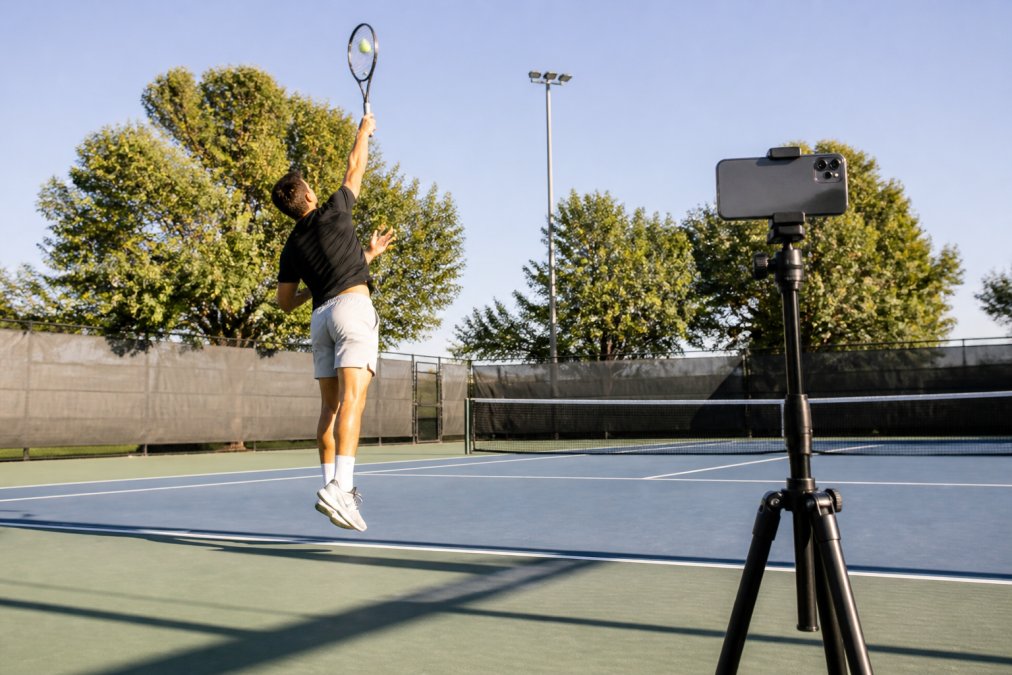
You need minimal equipment: a smartphone with a decent camera, a basic tripod, and a tennis ball hopper to stabilize it. Avoid handheld filming, camera shake destroys the biomechanical detail coaches need to assess your kinetic chain and swing path.
Camera Angles That Capture Footwork and Swing Path
For groundstrokes, position the camera at the baseline perpendicular to your hitting direction at hip height. This captures footwork patterns, hip rotation, and swing path through contact. For the serve, film from the service line side-on to capture the full kinetic chain from leg drive through trophy position to ball strike. A second angle from behind the baseline shows toss placement and swing path. For volleys, film from the opposite service box slightly elevated to capture court positioning, split step timing, and racket preparation.
Film at least 10-15 repetitions of each stroke per session. One or two swings give a coach almost nothing to work with. Patterns only emerge across multiple attempts, and coaches need to see both good and bad executions to identify root causes of technical errors.
Building a Consistent Video Feedback Loop
A consistent video feedback loop is the engine of skill retention. Film, submit, receive feedback, implement corrections in practice, film again. The cycle should repeat every one to two weeks minimum.
Most players film only when playing well. Film when your serve is broken or backhand is misfiring, that footage has diagnostic value. According to the United States Tennis Association’s player development guidelines, consistent deliberate practice with clear feedback cycles is one of the most reliable drivers of long-term skill development in adult players. Keep a simple log of each feedback session noting specific corrections, prescribed drills, and reassessment timelines.
Best Online Tennis Coaching Platforms: What to Look For
The best platforms share non-negotiable qualities. Evaluate each option against these criteria.
Coaching credentials and experience. Look for coaches with documented competitive experience, a track record with players at your level, and clear coaching methodology. A coach who explains why they’re recommending a specific technical change is worth far more than one who just tells you what to fix.
Instructional curriculum structure. The best platforms deliver structured, progressive curriculum, not random video libraries. Look for challenge-based learning, skill-specific modules, and clear progression paths from your current level to your target level.
Personalized feedback mechanism. Generic video libraries are not coaching. A platform worth paying for provides actual feedback on your specific footage, not just access to pre-recorded lessons.
Community and accountability. Group sessions, forums, or peer review components add accountability that solo learning lacks. Players engaging with community around their training maintain higher practice efficiency and stick with programs longer.
Crunch Time Coaching addresses all four criteria. The platform delivers step-by-step daily instruction, specialized challenge-based curriculum, and both online and in-person training camp options.
The most important factor when choosing an online coaching platform is whether it delivers genuine personalized feedback on your footage, or just access to generic instructional videos. The difference is the difference between coaching and content consumption.
Real Limitations of Online Tennis Coaching
Online tennis coaching has genuine limitations worth naming clearly.
No real-time physical correction. A coach cannot reposition your grip, adjust your stance, or physically demonstrate movement patterns. For kinesthetic learners, this is a real gap.
Self-filming requires consistency. The video feedback loop only works if you actually film regularly and submit footage. Players who struggle with self-directed practice often find that in-person session accountability kept them consistent.
Internet access and equipment. While setup requirements are minimal, reliable internet and a smartphone capable of slow-motion video are baseline requirements.
Injury assessment limitations. A coach reviewing video cannot perform physical assessment. For players managing tennis-specific injuries, pair online coaching with appropriate medical or physiotherapy guidance.
Do not attempt to self-correct multiple technical issues simultaneously. This overwhelms motor learning capacity and typically makes technique worse before it gets better. Work on one correction at a time.
Hybrid Coaching Models and Long-Term Progression Tracking
Hybrid coaching models combine remote instruction’s cost-effectiveness and flexibility with periodic in-person sessions for hands-on technical work. This is the best of both approaches for serious competitive players.
The typical structure involves consistent online coaching for technical development and video feedback loops, paired with quarterly or seasonal in-person intensives for physical correction and match play simulation. The in-person component handles kinesthetic learning that remote instruction cannot replicate. The online component handles volume, consistency, and progressive curriculum that weekly in-person sessions rarely deliver.
Long-term progression tracking is where hybrid models separate themselves. By maintaining a continuous video archive of your strokes across months and years, you build an objective record of technical development. Comparing your serve mechanics from six months ago against today’s footage is more informative than subjective improvement sense. For competitive players preparing for league or tournament play, this progression record informs tactical preparation by revealing patterns in footwork errors under pressure or predictable shot selection tendencies.
According to [research on motor skill acquisition from the(/how-to-volley-beginner-tennis-lessons/) American College of Sports Medicine | acsm.org], long-term skill development requires sufficient practice volume and quality feedback over time. Hybrid coaching models are structurally well-suited to deliver both.
Who Gets the Most Out of Remote Instruction
Remote instruction delivers strongest results for specific player profiles.
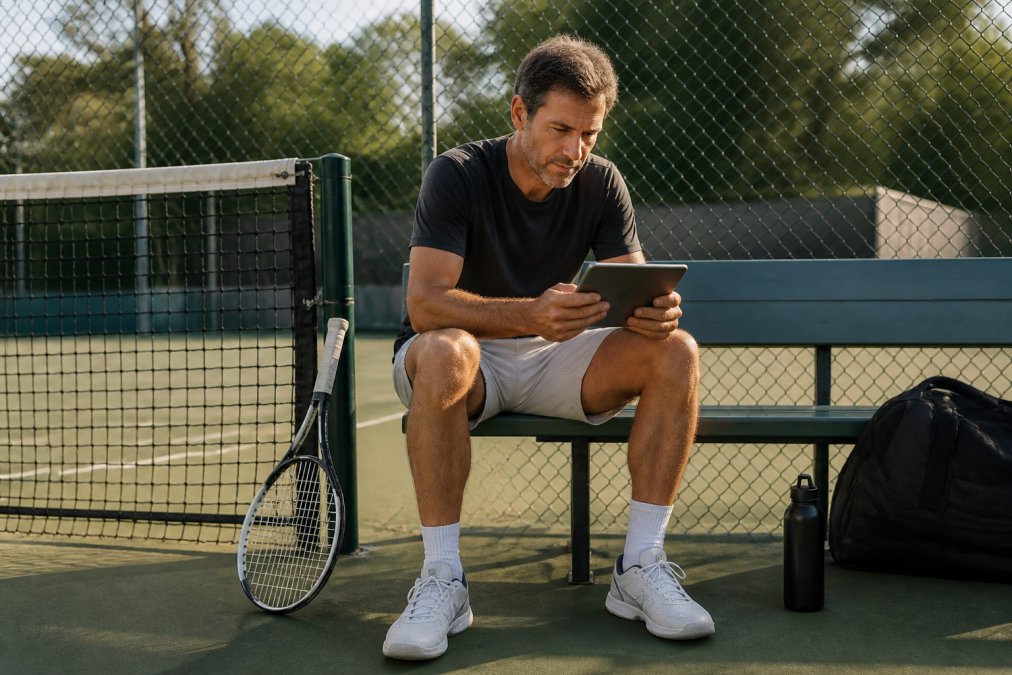
Intermediate to advanced players on a performance plateau. If you’ve played for years and feel stuck, online coaching’s emphasis on technical analysis and deliberate practice is calibrated for this problem. Video feedback identifies specific biomechanical inefficiencies that generic group instruction never addresses.
Adult players returning to competitive tennis. A player rebuilding technical proficiency while managing an older body’s physical realities benefits from online coaching’s injury prevention content and flexible scheduling without weekly in-person time pressure.
Players in geographically underserved areas. High-level coaching concentrates in major metropolitan areas. Online coaching removes geographic constraints entirely.
Players preparing for league or tournament competition. Structured technical development, tactical awareness curriculum, and mental conditioning content map directly onto competitive match play demands.
Complete beginners benefit less from online coaching. Without foundational technical grounding, self-directed practice from video feedback is limited. Beginners benefit most from in-person instruction first, transitioning to online coaching once basic stroke production is established.
The challenge most competitive players face isn’t finding information about tennis. It’s finding personalized, progressive instruction that actually changes how they perform under pressure. Crunch Time Coaching delivers exactly that through daily step-by-step lessons, challenge-based curriculum built for competitive development, and in-person training camp options for players wanting hands-on coaching. If you’re serious about reaching a higher level of play, the platform’s structured approach to technical skill development and mental conditioning gives you a genuine path forward. Reserve Your Spot Today and start building the game your competition hasn’t seen yet.
Frequently Asked Questions
What are the main disadvantages of online tennis coaching?
The biggest limitation is the absence of real-time correction during live play. A coach watching video cannot physically adjust your grip or stance mid-stroke. Court conditions, ball speed, and live match pressure are also hard to replicate on screen. That said, structured video analysis with a qualified coach still catches most biomechanical inefficiencies, especially in stroke production and footwork patterns, that players miss entirely on their own.
Can online tennis coaching help beginners improve technique?
Yes, though beginners benefit most when the platform pairs video feedback with a clear, structured instructional curriculum rather than generic tips. Deliberate practice guided by a certified coach, even remotely, builds correct muscle memory faster than unguided repetition. Beginners should prioritize platforms that offer personalized feedback on submitted footage rather than pre-recorded lessons alone, since individual technical errors vary significantly from player to player.
How does online tennis coaching compare to private, in-person lessons?
Private in-person lessons offer immediate, real-time correction and physical demonstrations that video cannot fully replicate. Online coaching trades that immediacy for flexibility, lower cost, and access to coaches regardless of geography. For players working on serve mechanics, footwork patterns, or shot selection between in-person sessions, online coaching functions as a high-value complement. Many competitive players now use a hybrid model: periodic in-person intensives combined with consistent remote instruction for ongoing skill retention.
What equipment do I need for effective online tennis instruction?
The essentials are a smartphone with slow-motion video capability (most modern phones qualify), a sturdy tripod, and reliable Wi-Fi or mobile data for uploads. A wide-angle lens attachment helps capture full court coverage. For live video sessions, a tablet propped courtside works better than a phone. Good lighting matters more than camera resolution, filming in direct midday sun or deep shade makes biomechanical analysis significantly harder for any coach reviewing your footage.
This article was written using GrandRanker